2025-12-07
From December 6th to 7th, the 2025 (23rd) Annual Meeting of Influential Entrepreneurs (formerly the Annual Meeting of Chinese Business Leaders), hosted by *China Entrepreneur* magazine, was held in Beijing. Liu Yonghao, Chairman of New Hope Group, attended the meeting and delivered the opening speech.
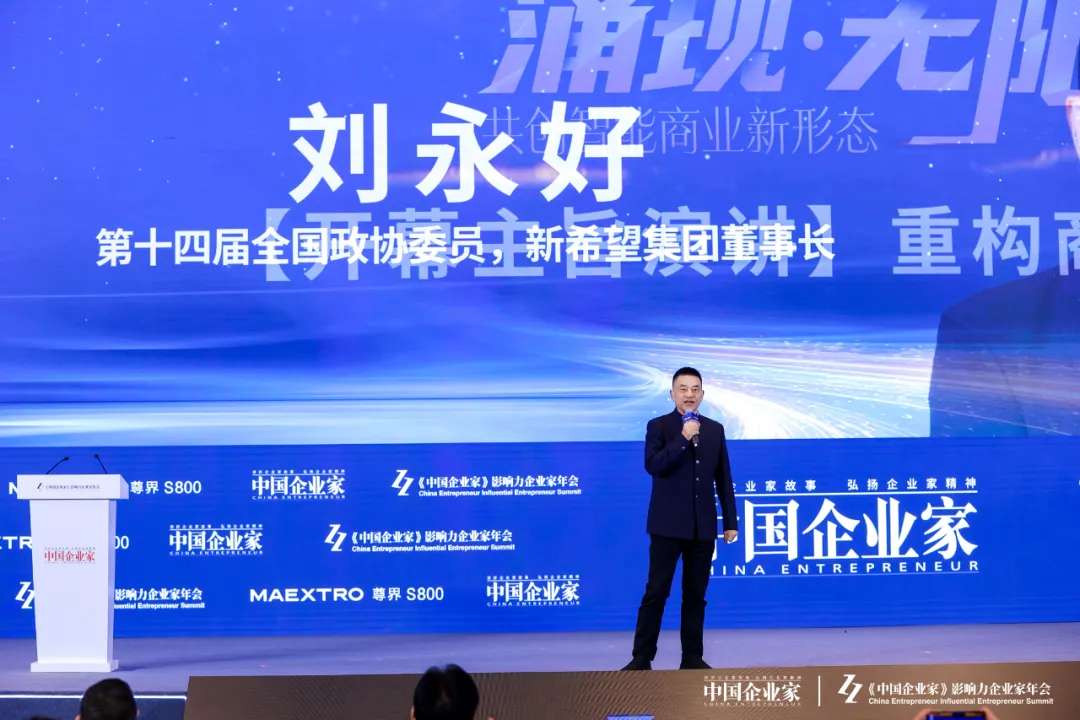
The following is a transcript of Liu Yonghao's speech (edited):
*China Entrepreneur* magazine has been around for 40 years, accompanying a generation of Chinese enterprises from nothing to something, from small to large. Chinese entrepreneurs are remarkable, growing and developing alongside the country. As one of the entrepreneurs, I am very happy.
I would like to use the development case of our company over the past forty years to talk about Chinese entrepreneurs and their spirit. For 40 years, Chinese enterprises have been witnesses, participants, and beneficiaries of the times.
In January 1992, my four brothers and I had been running our business for 10 years. At that time, we studied together the article "The East Wind Brings Spring Everywhere." This report talked about reform, opening up, and development, which greatly encouraged private enterprises. The development of China's private enterprises was marked by milestones in 1984 and 1992, both years worthy of attention.
At this crucial juncture, *China Entrepreneur* magazine was founded in 1985, dedicated to "telling the stories of entrepreneurs and promoting the entrepreneurial spirit." Many entrepreneurs enjoyed reading it; I read almost every issue. I attended the Influential Entrepreneurs Annual Meeting most of the time. Over the past 40 years, I've probably attended twenty or thirty times. Congratulations to *China Entrepreneur* magazine, and congratulations to all Chinese entrepreneurs.
Today, my three brothers and I are all in our seventies and eighties, still in good health and with positive attitudes. On February 17th of this year, I attended the symposium on private enterprises convened by the central government, where I, as a representative of private enterprises, reported to the nation. There's a photo that captures the early days of our business in the 1980s, showing my third brother and me standing in a quail farm; I was a little thinner then.
Our factory has grown larger and larger, developing and growing alongside other private enterprises and the entire Chinese economy. Not only in China, but we also have dozens of factories overseas, employing approximately 10,000 to 20,000 people. We've expanded globally, establishing a presence in the United States, Australia, New Zealand, and many countries and regions in Southeast Asia, following the Belt and Road Initiative.
We come from a small place in Xinjin, Sichuan. There's a photo of us in front of the Yuxin Seed Farm in 1982; from that place, we expanded nationwide. In 2022, I attended an overseas employee and partner sharing session. Most of the attendees were overseas employees. As investors and leaders of the company, we shared with our overseas partners how we contribute to society.
On May 25, 2025, my daughter, Liu Chang, attended a symposium for Chinese-funded enterprises in Indonesia, specifically for companies "going global." On November 18, 2025, New Hope held a "Rural Revitalization Plan Forum" at its factory in Egypt, receiving strong support from the Egyptian government. New Hope has truly gone from a small place to the world.
Here, I'd like to summarize some of our experiences in "going global." First, there's "one higher": compared to the income levels in these places, especially for employees in countries participating in the Belt and Road Initiative, our income is generally 30% higher than that of similar enterprises. This helps retain employees, and they are more willing to work for us. Second, there's "two respects": respecting their culture and laws. Third, there's "three disseminations": disseminating Chinese culture, promoting Chinese manufacturing, and spreading the spirit of Chinese entrepreneurs.
Because we follow this "one-two-three" approach, we have built factories in many countries and regions around the world and achieved success, revitalizing traditional agriculture with new productivity. The factory buildings built in 1984 cost only 300 yuan per square meter to construct, while today's feed mills are largely automated with robots, resulting in a significant change in the landscape.
Therefore, entrepreneurs must be at the forefront, proactively winning market competition with high-quality products and services.
Innovation is not only a requirement for transformation but also the lifeblood of an enterprise. A few days ago, at Southern University of Science and Technology (SUSTech), I signed a strategic cooperation agreement with President Xue Qikun between New Hope Group and SUSTech. We hope to leverage SUSTech's research and teaching strengths, combined with our group's advantages, to jointly promote university-enterprise cooperation and take our technological advancement to a new level.
Our group has directly participated in numerous scientific research projects and has won eight second-class National Science and Technology Progress Awards. We have also undertaken eight major national science and technology projects. Therefore, as long as traditional enterprises are equipped with new quality productivity, they can still stay at the forefront, meeting the needs of the people while also achieving development.
For example, we proposed using new technologies to meet the demand for "freshness," which is a manifestation of new quality productivity. Many people are concerned about how new quality productivity will develop under the current wave of artificial intelligence, and how traditional enterprises should respond. Some think it has nothing to do with us. No, it does, and it's reflected in a glass of milk, a pig, and a piece of meat.
Take responsibility as an example. I remember when I was a child, our neighbor next door raised a cow. Every day, he would milk the cow, riding a bicycle or carrying a load on a shoulder pole, holding a "clang"—sometimes made of bamboo, sometimes of sheet metal—and everyone knew fresh milk had arrived. It had a layer of milk skin and tasted delicious.
Can we still produce milk of the same quality as that "clang" milk from back then? Absolutely! And we have achieved it. After milking on the same day, the milk undergoes processing, packaging, cold chain logistics, transportation, and distribution to stores—all completed on the same day. This is thanks to new-quality productivity, our modern cold chain logistics technology, and the support of artificial intelligence.
This sounds easy, but it's not simple to do.
As a large-scale enterprise with sales in major cities across the country, producing and selling fresh milk on the same day, we are the first in the world to achieve this, earning widespread recognition. Because of this, New Hope Dairy achieved revenue growth despite previously unfavorable price levels and significant industry pressure.
We meet the demand for "freshness" with new-quality productivity and new technologies, supported by a robust fresh-life cold chain. We deliver to over 1 million stores daily, with over 300,000 cold chain logistics vehicles deployed nationwide, serving 2,800 districts and counties, making us a leading enterprise in China's cold chain logistics industry.
This is the concrete measure of equipping the most traditional industry with new-quality productivity. We emphasize continuous learning, innovation, and iteration; to this end, we have organized two large-scale learning sessions. In 2021, we spent six months conducting specialized training for the Harvard Digital Transformation Strategy Acceleration Project. This year, another 2,600 middle-level managers and technical backbone personnel participated in new learning programs on leadership and artificial intelligence.
We aim not only to cultivate everyone's interest but, more importantly, to foster their understanding of new quality productivity and artificial intelligence. We organize study tours to various regions to learn from advanced enterprises and artificial intelligence, which has been extremely enlightening for us.
On the other hand, under the new landscape, we must also shoulder our responsibilities. A few days ago, the China Guangcai Program Promotion Association held its seventh leadership election. I was very pleased to be elected, along with several veteran entrepreneurs, as honorary vice presidents of the China Guangcai Program Promotion Association. Although it is an honorary position, I still feel proud and honored. From the inception of the Guangcai Program Promotion Association to today, 30 years later, our Guangcai Program has made positive contributions to the development of private enterprises, to China's poverty alleviation efforts, and especially to the "Ten Thousand Enterprises Revitalizing Ten Thousand Villages" and "Ten Thousand Enterprises Helping Ten Thousand Villages" initiatives.
New Hope's 30-year journey under the "Glorious Cause" initiative has been anything but simple. Shortly after the initiative was launched, the first factory nationwide under this initiative, the Liangshan Xichang Hope Feed Mill project with an investment of 15 million yuan, was completed. In 2018, we built a pig farm in Tekoujiagu Village, Liangshan, Sichuan. We built the factory jointly with local Yi farmers and even shared profits with them, which made me particularly happy.
In 2021, I and nine other private entrepreneurs launched the "Let Us Actively Participate in the 'Ten Thousand Enterprises Revitalizing Ten Thousand Villages' Action." In 2020, New Hope proposed the "Five-Five Project" for rural revitalization. We, along with other entrepreneurs, will work together to accomplish five things over five years:
First, drive 50 billion yuan in rural investment; second, create 50,000 new agricultural jobs; third, provide public welfare training for 50,000 green-collar new farmers; fourth, serve 50,000 agricultural entities; fifth, build five rural revitalization demonstration bases. One is a livestock farm in Tekoujiagu Village, deep in the Daliang Mountains at an altitude of 3,000 meters; another is a rural complex in Hengkantou Village, Yuyao, Zhejiang; and the third is a talent training base established in my hometown. Adding to these, the smart pig farm in Shibing, Guizhou, and the comprehensive talent cultivation demonstration base in Shandong, we have established five rural revitalization demonstration bases.
Under the new framework of rural revitalization, we also have new models. For example, we developed tree tomato hot pot base in Yunnan, which has now become a hot-selling product. We sell two to three hundred million yuan worth of it annually through Hema and Sam's Club alone, and this product has only been on the market for a year. Many people are unaware of this local tree tomato, but after collecting it, it can be processed into products and used as a base, which is very popular in the market.
Furthermore, the Pingba grey geese in Guizhou are raised very well. We have empowered them with technology and expertise to raise them even better, which is also a demonstration base for rural revitalization. As the president of the Sichuan Chamber of Commerce, a leader asked me to give the Sichuan Chamber of Commerce a task: Liangshan has planted 2 million mu of Sichuan pepper for poverty alleviation; could you help us sell it and contribute to rural revitalization?
We started brainstorming and finding solutions. At the Rural Revitalization "Village Chief Class," the village secretary of Tianxing Village in Liangshan spoke, expressing some anxiety about the village's pepper industry and hoping the "Village Chief Class" could help him solve his problems. Our Rural Revitalization "Village Chief Class" has been held five times, with over 500 village chiefs and party secretaries participating, impacting over 4,000 villages, and has been selected as one of the first outstanding case studies in the national "Ten Thousand Enterprises Revitalizing Ten Thousand Villages" initiative.
As an agricultural entrepreneur, some people call me an "old farmer." The first lesson of each Rural Revitalization "Village Chief Class" is my first lesson as an "old farmer." The first class was in 2021, and one of our participants was the secretary of Zhanqi Village. I used to think village chiefs and party secretaries were all old, but this secretary was a graduate student from the School of International Relations at Peking University; she went there to serve as secretary.
The second Village Chief Class was held in my hometown of Xinjin, where we exchanged ideas with village chiefs and party secretaries on solving difficulties and problems. In the third class, Qu Muwuha, an Yi ethnic minority participant, helped me put on a hero's knot and thanked us for our contributions to local rural revitalization.
The fourth event was held in Hengkantou Village, Zhejiang Province, where we exchanged ideas on how to revitalize rural areas.
The fifth event just concluded a few days ago. A leader from Jiagu Village in Liangshan Prefecture created Yi embroidery cultural and creative products, which she gave to me, hoping to help them increase the income of local villagers. This young woman also studied in Beijing and returned to work after graduating from university. As an old farmer, I feel it's very valuable to participate in such activities.
Under the new circumstances, private enterprises not only need to perform well but also contribute to society. Building confidence, seeking opportunities, and standing at the forefront of trends, hoping to make life better—this is our goal. This is my speech as an old farmer and an old entrepreneur on the 40th anniversary of *China Entrepreneur* magazine. Thank you.

 Tel:028-65721666
 Address:No. 366 Jinshi Road, Jinjiang District, Chengdu City, Sichuan Province, Zhongding Internationa
 Email:contact@newhope.cn
 New Hope Group Official Account
 New Hope Audit Official Account
 Yonghao Foundation Official Account
© 新希望集团2025 蜀ICP备09024865号